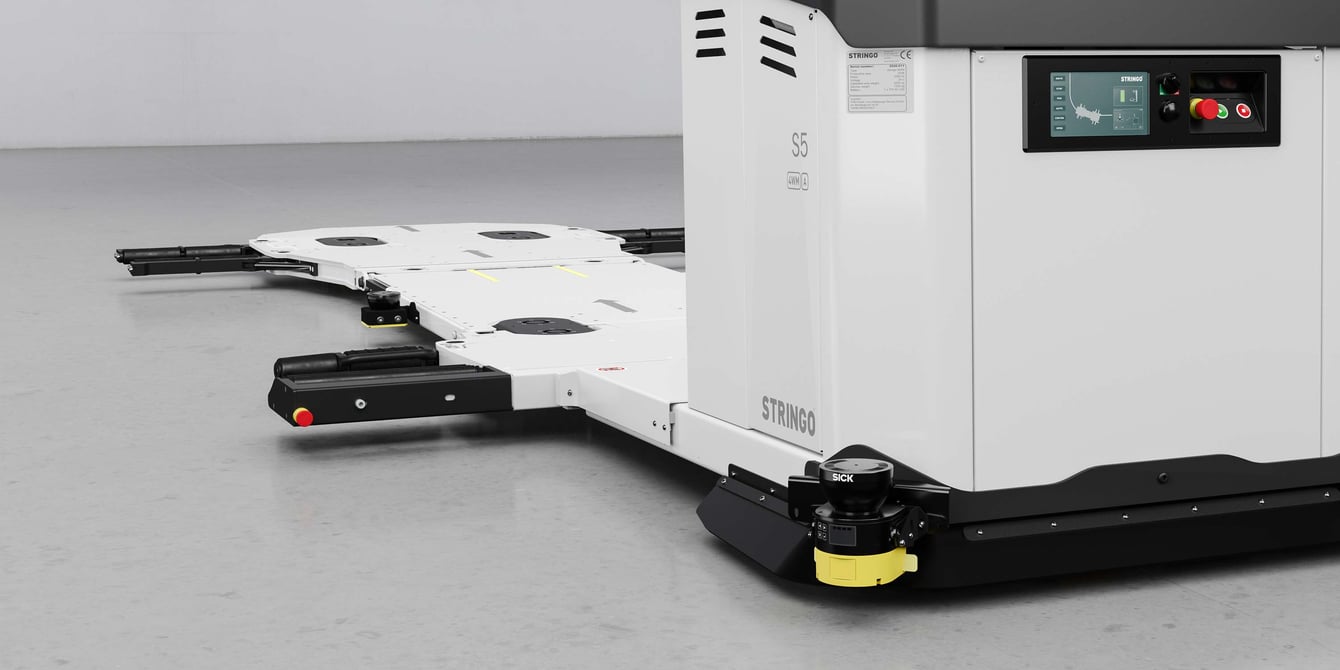
How will a vehicle mover that’s flexible by design help future-proof your automotive manufacturing or testing facility? Explore the strategic choices behind Stringo Automated’s open platform setup, multi-directional steering, and ability to switch between autonomous and manual operation.
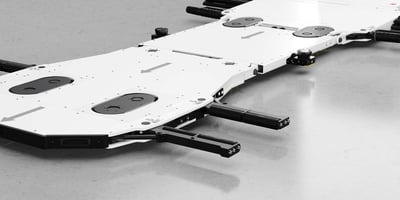
Stringo Automated is specifically developed to support the increased demand for automation in the automotive industry. The model retains all the core advantages of Stringo’s classic vehicle movers — power, stability, and long-term durability — while adding new levels of autonomy and flexibility. In this article, Stellan Robertsson, Project Manager in Stringo’s R&D team, explains how this combination makes it a perfect fit for modern AGV environments.
3 ways Stringo Automated is designed for flexibility
1. Open platform architecture: made to integrate
Equally central to the new generation of Stringo is its open platform approach. Built on a robust CAN bus communication interface, Stringo Automated is engineered for maximum technical freedom — enabling seamless integration with virtually any navigation or fleet management system on the market.
“The open architecture gives our customers freedom,” says Stellan. “We don’t lock you into a proprietary system. Instead, we collaborate with system integrators and AGV partners to ensure our machines fit seamlessly into the tech structure you’re already using in your facility,” Stellan explains.
2. Manual, remote, or autonomous operation: the choice is yours
Another flexible aspect of Stringo Automated is how you operate it. The machine is built for autonomous driving and seamless integration with your AGV systems, but can easily be switched to manual or remote-control mode whenever needed.
“There will always be situations where human control is the fastest and safest option,” says Stellan. “You might need to move a vehicle for service, or reposition a car outside the predefined AGV route. To support this, we have the possibility to keep the familiar handle control and intuitive manual driving experience from our classic models.”
3. Stringo OmniDrive™: movement in every direction
From an engineering perspective, the most significant change introduced with Stringo Automated is the multi-directional manoeuvrability. Stellan elaborates on the shift:
“Steering a traditional Stringo is pretty much like reversing a car. The steering is all in the back wheels, while the front wheels are fixed. It’s a robust design, but requires more maneouvring space than what’s optimal in the tight factory spaces where AGVs typically operate.”
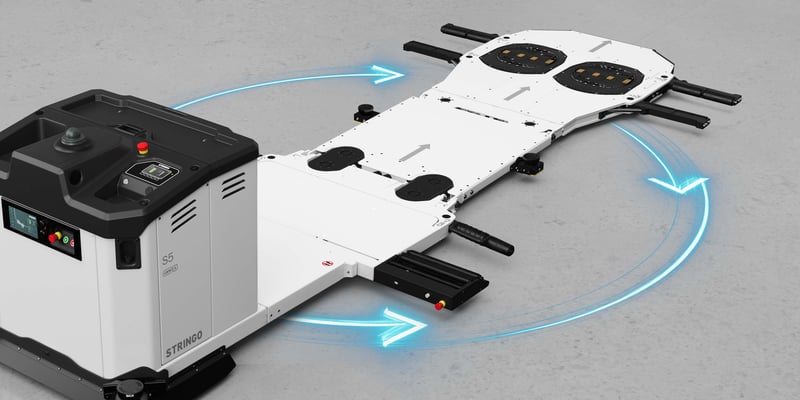
With the newly developed Stringo OmniDrive™ system, both the front and rear end of the machine have rotatable and steerable wheels. This minimises the turning radius and allows the vehicle mover to move smoothly in any direction: sideways, diagonally or rotating on the spot.
“When the machine operates in an AGV setting, it may have to be able to make very small, precise movements, for example to adjust its position before loading a vehicle. Getting the Stringo OmniDrive™ system in place has been crucial to cater to these needs,” says Stellan.
A new role of vehicle movers in automotive manufacturing and testing
The introduction of Stringo Automated marks a change in how vehicle movers are utilised in automotive manufacturing; a change that goes hand in hand with the evolution of the industry:
In a traditional factory, each finished car must be manually driven from the end of the production line to its next destination, and the operator then has to walk back to fetch the next one,” Stellan explains. “With Stringo Automated, this entire movement can be fully automated — or the Stringo Automated can be used selectively to handle exceptions, such as vehicles that cannot be driven.
In the age of automation, however, using a vehicle mover becomes the rule, rather than the exception:
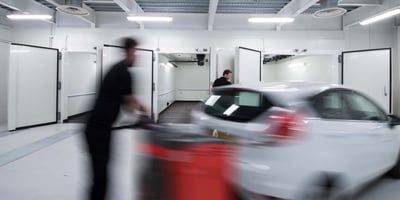
“Whenever a vehicle needs to be moved from A to B along a pre-programmed route, Stringo Automated can operate as part of a continuous AGV flow. The typical use case is collecting finished vehicles at the end-of-line, but it can also move cars in and out of dyno cells in a testing facility.”
In both cases, the goal is to improve safety and efficiency by automating workflows, which in turn minimises situations where human operators are put at risk.
How does Stringo Automated compare to light flatbed options?
Read the article where Stringo’s CTO Magnus Grafström breaks down the top six factors that set Stringo’s latest model apart from lightweight flatbed models.