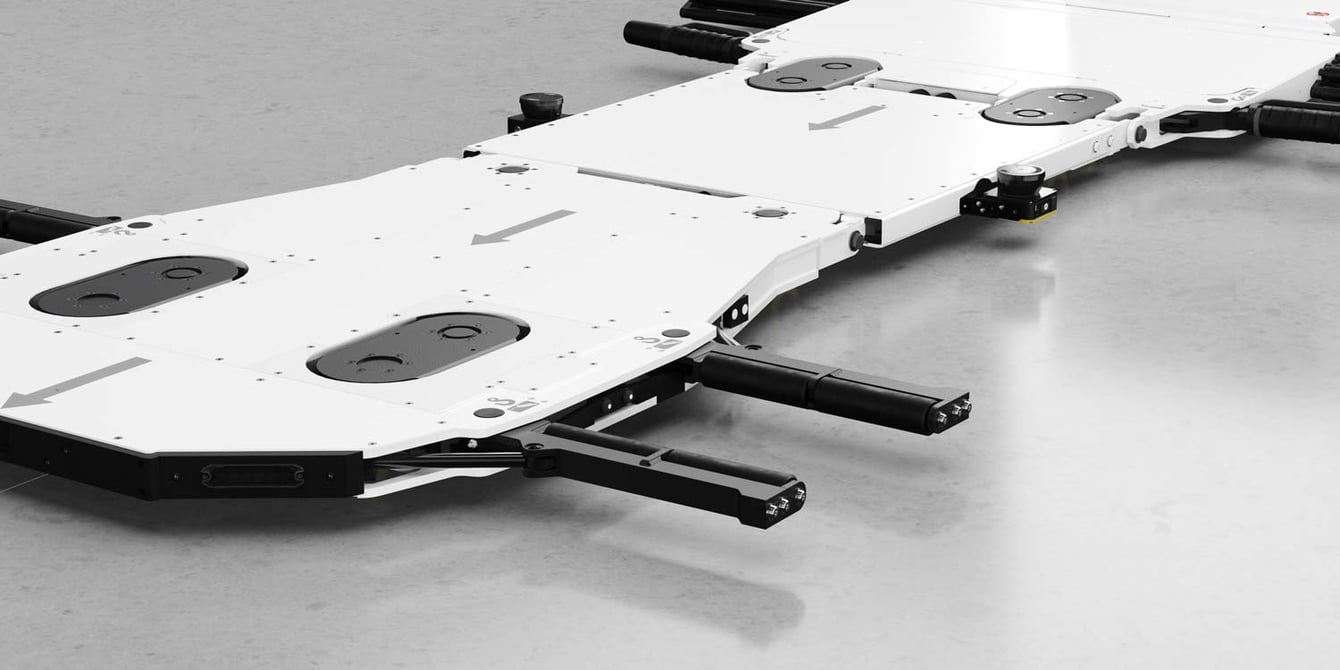
With automation on the rise in the automotive sector, manufacturers are shifting from static production lines to modular and flexible setups. Autonomously operated vehicle movers are a crucial part of the puzzle. But which solution is best suited for your car factory? Get a quick breakdown of how more robust machines compare to light flatbed models in a heavy industry setting.
Responding to evolving industry demands, the Stringo R&D team has developed a brand-new model. Stringo Automated combines the strength and robustness of manually operated vehicle movers with AGV features such as autonomous operation and multi-directional steering. So, what are the main differences between this new machine and the autonomous flatbed solutions that are becoming increasingly popular, particularly within parking and storage?
Magnus Grafström, CTO of Stringo, provides some context from an R&D perspective:
“Designing and constructing a machine always involves a degree of compromise. You prioritize one thing at the cost of something else. The compact size of the flatbed models offers great benefits, such as the ability to swiftly access a vehicle from any direction. This is very useful for moving cars quickly on a smooth surface, such as in a parking garage. But by design, these machines have a limitation when it comes to power and robustness. And these are crucial factors in an industrial environment.”
Let’s take a deep dive into how the most recent Stringo model is adapted to fit the needs of modern car factories – and why flatbed options often fall short.
6 benefits of using Stringo Automated in your automotive manufacturing facility
1. Robust and powerful performance
Stringo Automated is constructed for high-intensity usage. Compared to light flatbed models fitted with electric actuators, its powerful drive motor and hydraulic press arms enable it to lift heavier loads, and to do so more quickly. Stringo Automated has the capacity to move vehicles weighing up to 5 tons, or up to 4.2 tons with Stringo OmniDrive™. A Stringo can also move vehicles up and down sloping surfaces with gradients over 5%.
2. High battery capacity and runtime
The larger volume of a Stringo offers more space for battery installations, resulting in longer operating times and fewer interruptions to your operations due to frequent charging.
3. Even ground pressure distribution
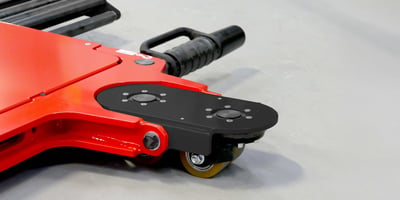
The Stringo bogie wheel construction, in combination with added support wheels, distributes ground pressure evenly across a larger surface area, reducing floor wear and ensuring smooth, stable movement.
4. Flexible operation: autonomous and manual
Stringo Automated is built for autonomous operation. But whenever the situation requires the machine to be moved manually (for example, when it needs to be serviced), a single operator can operate it just as safely and easily as a traditional Stringo.
In contrast, flatbed models typically rely on external devices like tablets for manual control, which tends to be slower and less intuitive.
“I recently visited a car manufacturer looking into using a flatbed model in their end-of-line process. In situations that required manual operation, they found it took their operators about ten minutes to move a car manually with the flatbed, compared to just two minutes with a Stringo,” says Magnus.
5. Safe work environment
The Stringo’s size and upright design make the machine hard to miss, even in a hectic industrial setting. We put safety first with easily accessible emergency stop buttons, and to further improve visibility it can easily be equipped with additional safety features such as warning lights and sound signals, alerting staff around your facilities to keep out of its way.
6. Open platform architecture
Instead of locking you into a proprietary system, the Stringo R&D team has chosen an open platform approach. This way, Stringo Automated can be integrated into the existing tech infrastructure of your manufacturing or testing facility.
“The flatbed companies tend to have a strong software focus, while the Stringo expertise lies mainly in mechanical engineering. To offer our customers the best of both worlds, as well as complete flexibility, we’re collaborating with external partners to ensure smooth integrations with AGV, AMR, and material handling systems,” Magnus explains.
“Our mission is to support the automotive industry”
With all the above said and done, “The benefits of keeping our robust design and adapting it to autonomous operations outweigh the potential gains of building a lighter machine,” Magnus Grafström explains.
“We have worked closely with automotive manufacturers for decades, and we know that robustness is a crucial factor in an industrial environment. Our mission is to support the automotive industry with solutions for safe and efficient vehicle moving. We’ve done it successfully for forty years by constantly evolving, and that’s what we’ll continue to do.”
Learn more about the flexibility of Stringo Automated
Don’t miss the article where Stellan Robertsson, Project Manager in the Stringo R&D team, explains how flexibility by design helps future-proof your automotive operations.