For manufacturers producing thousands of vehicles per day, investing in large-scale conveyor systems is often seen as a natural part of the production process. But what about the companies producing hundreds, dozens, or even just a handful of vehicles each week?
Across industries such as motorhomes, ambulances, special-purpose vehicles, defense applications, and vehicle conversions, manufacturers face many of the same challenges as major automotive OEMs. They require repeatable processes, consistent quality, traceability, and efficient production flows—without the production volumes that justify a traditional conveyor-based line.
As product variants increase and customer demands become more specialized, the need for flexible and scalable production solutions continues to grow.
“The challenge isn’t achieving automotive-grade quality. The challenge is achieving it without automotive-scale volumes.”
The reality of low-volume production
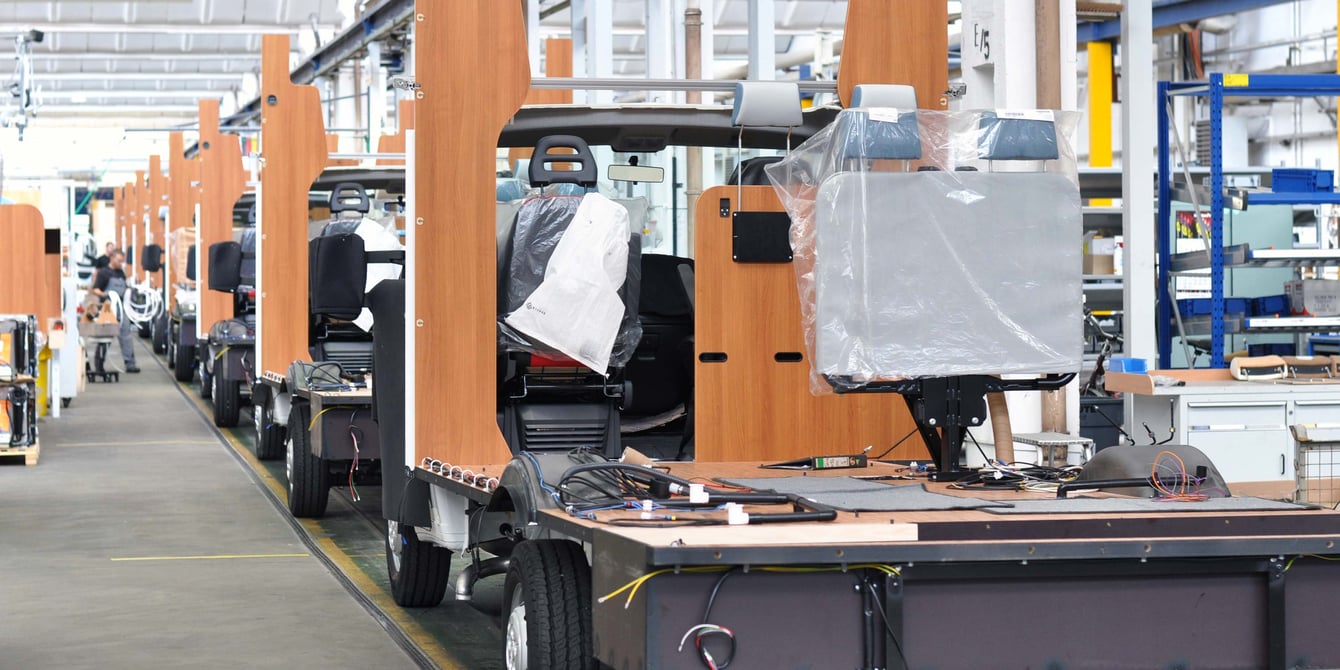
A motorhome manufacturer may receive a chassis from a vehicle OEM, but everything that transforms it into a finished vehicle happens afterwards. Interior installations, electrical systems, testing, inspections, and customer-specific options all need to be managed through a structured production process.
The same is true for ambulance manufacturers, emergency vehicle builders, and other specialized vehicle producers. While volumes are relatively low, quality requirements are often exceptionally high, and many vehicles are built to unique customer specifications. Despite this complexity, many facilities still rely on manual vehicle movement and production layouts that were never designed for flexibility.
When the conveyor doesn’t make sense
Traditional conveyor systems excel in high-volume production, but they require major investments, lengthy installation projects, and a long-term commitment to a fixed layout.
For low-volume manufacturers, that investment is often difficult to justify. Conveyor systems can cost millions before production even begins, and modifying them later can be both expensive and disruptive. In environments where requirements change frequently, fixed infrastructure can quickly become a limitation.
A production line built around flexibility
What if a production line could be structured and automated without being physically fixed?
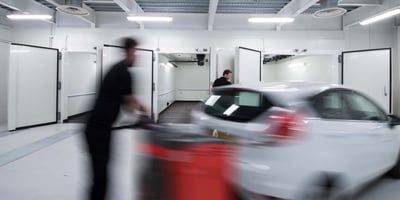
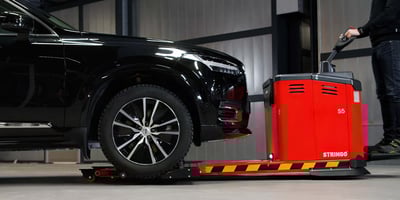
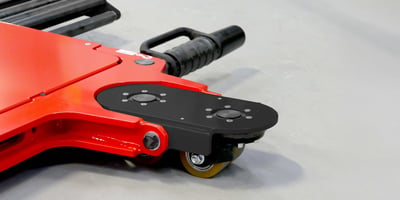
With Stringo Automated, autonomous vehicle movers create a dynamic production flow without the need for embedded conveyors, chains, or tracks. Vehicles can be routed automatically between workstations, inspection areas, testing stations, and buffer zones while maintaining a structured and repeatable process. The key advantage is flexibility. Adding a workstation, changing a process sequence, or introducing a new vehicle type can often be achieved through software configuration rather than factory reconstruction.
Designed for integration, not limitation
Automation should adapt to existing operations—not the other way around.
Stringo Automated features an open architecture that enables integration with ERP systems, MES platforms, and existing automation solutions. Manufacturers can build automation around their current processes while maintaining the freedom to evolve as requirements change. For low-volume producers, where product mixes and workflows frequently change, this flexibility is particularly valuable.
Automotive thinking without automotive costs
Large automotive manufacturers have demonstrated the value of structured production flows, automation, and digital traceability. Traditionally, however, achieving these benefits required investments that only the largest producers could justify.
By combining autonomous vehicle movement with software-driven orchestration, manufacturers can achieve many of the advantages of automotive-scale production without investing in automotive-scale infrastructure.
The future belongs to adaptable manufacturers
Low-volume production does not mean low standards. In many cases, it means managing greater complexity with fewer resources and tighter margins. The manufacturers that will succeed are those capable of combining flexibility with structure, customization with efficiency, and quality with adaptability.
The question is no longer whether automation has a place in low-volume production.
The question is how to achieve it without inheriting the cost and rigidity of traditional manufacturing infrastructure.
Learn more about the flexibility of Stringo Automated
Don’t miss the article where Stellan Robertsson, Project Manager in the Stringo R&D team, explains how flexibility by design helps future-proof your automotive operations.